CycloAid
CycloAid
The Masterbatch That Changes Everything: How CycloAid Makes Incompatible Plastics Work Together
Barrier packaging is difficult to recycle. Incompatible materials form poor blends and make weak products. Here’s how a small dose of the right compatibiliser turns a failing blend into a strong, processable material — on the equipment processors already own.
Some of the most useful materials in plastics come from combining very different polymers. Barrier resins (nylon, EVOH and PET) protect food from the elements while HDPE brings toughness and moisture resistance. Together they form the basis of the multilayer barrier films found across food packaging.
There’s just one problem: these resins are fundamentally incompatible. One is polar, the other non-polar — chemically, they want nothing to do with each other. Blend them directly and the two phases separate at their boundary, leaving weak spots that crack, delaminate and fail. Ordinarily, this makes food packaging difficult to recycle
At Innomerix we developed CycloAid, a range of compatibiliser masterbatches, to solve exactly this. Here is a simple test that shows what it does.
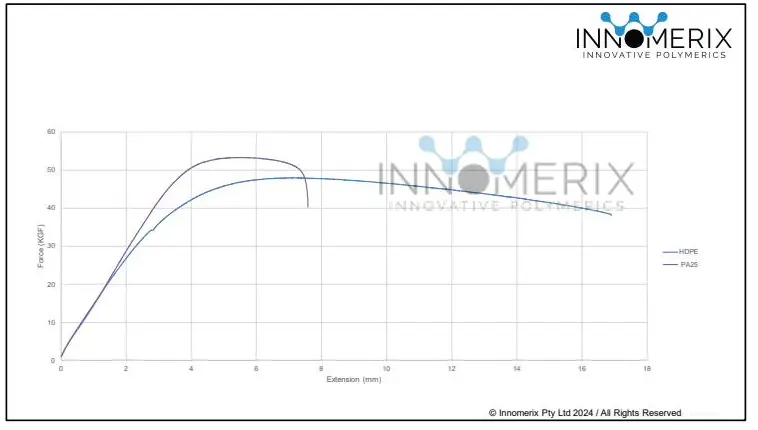
Under tensile stress HDPE (blue) yields gracefully; the 25% PA6 / HDPE blend, PA25 (purple), breaks early and abruptly
To simulate a multilayer barrier film, We blended 25% PA6 into HDPE as a salt-and-pepper mix. This was moulded into test pieces without any specialised compounding equipment. The result is clear. Pure HDPE stretches and yields gracefully. The PA6/HDPE blend climbs higher in force, then breaks early and abruptly — the classic signature of two materials that will not bond. That early break point is poor compatibility, made visible.
Why it happens?
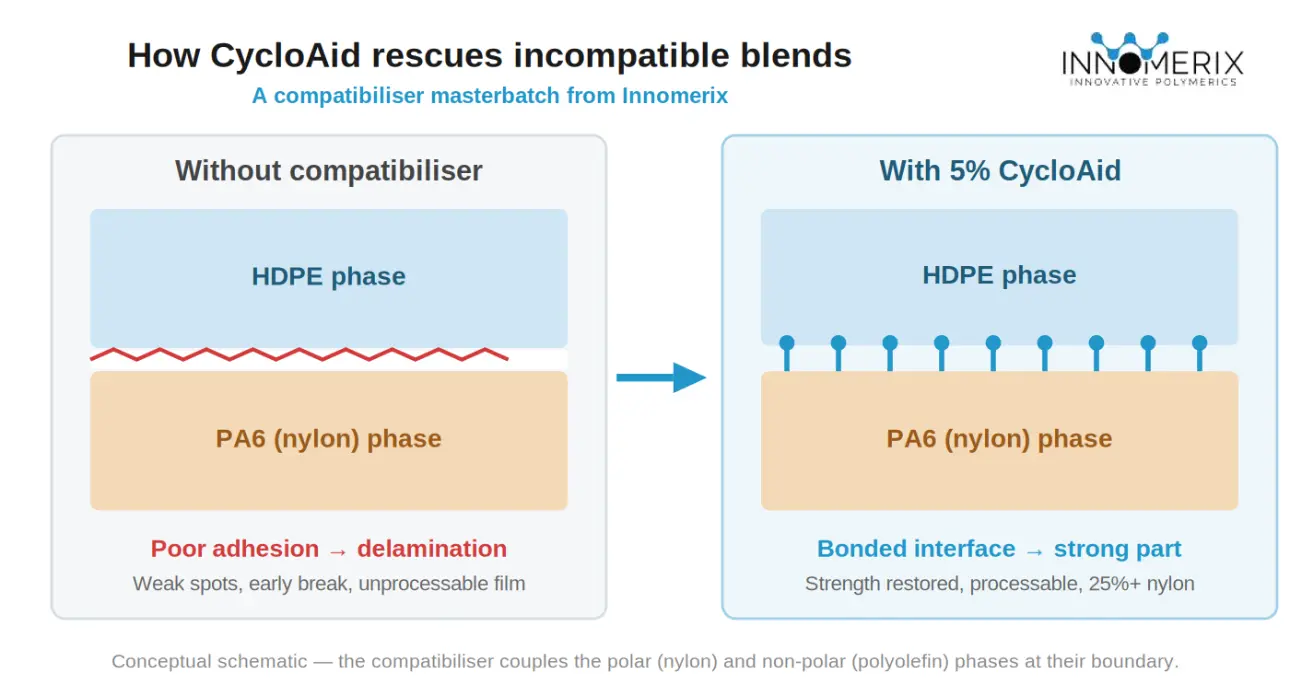
At the interface, untreated phases separate under stress. CycloAid couples the polar and non-polar phases so the blend behaves as one material
At the microscopic level, the nylon and HDPE form separate phases with a weak boundary between them. Under stress, that boundary is where the part gives way. A compatibiliser works right at this interface, coupling the two phases so the blend acts like one coherent material instead of two that are pulling apart.
Add 5% CycloAid
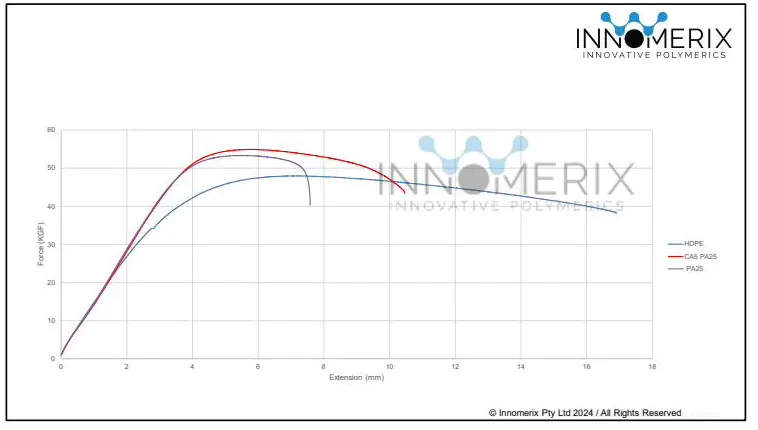
The same blend with 5% CycloAid PE 01 added, CA5 PA25 (red): strength and ductility restored, extending well past the untreated blend’s failure point.
Now we add just 5% of CycloAid PE 01 to the same blend. The difference is immediate. The treated blend regains much of its lost strength and ductility — extending well past the failure point of the untreated blend, while peaking higher than HDPE alone. Same simple processing; one extra ingredient.
You can see it, too
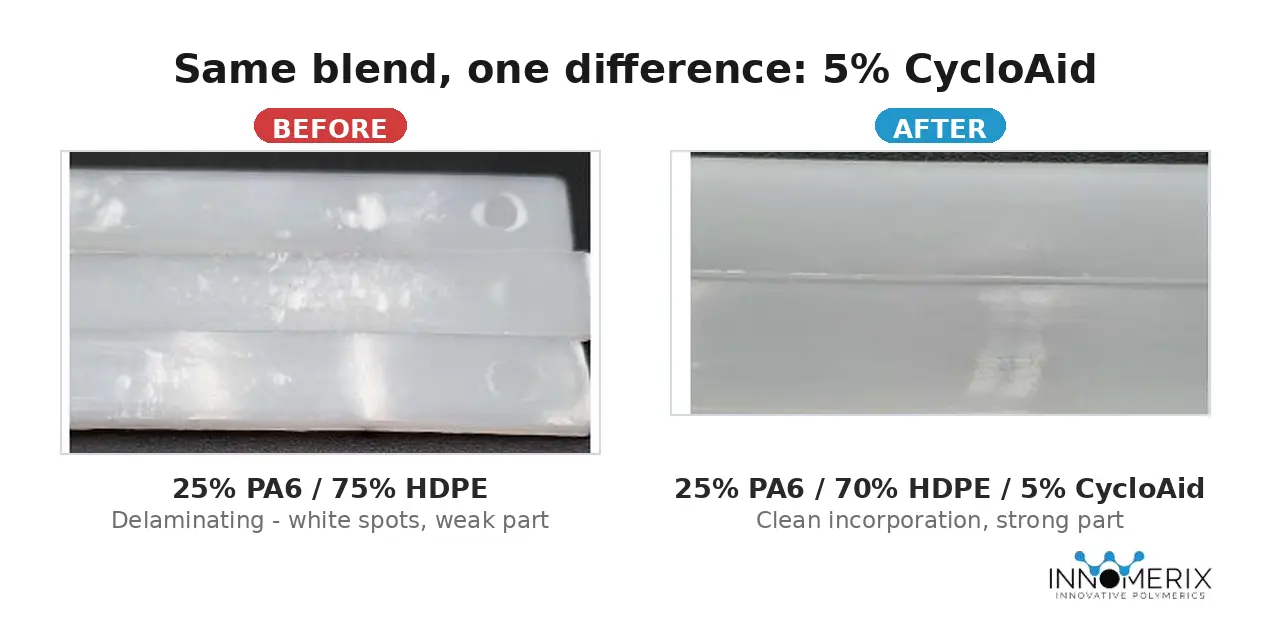
The same blend with 5% CycloAid PE 01 added, strength and ductility restored, and delamination eliminated.
The mechanical data is backed up by what the eye can see. On the left, the untreated blend shows white streaks where the two polymers delaminate — in blown film, this alone renders the material unprocessable. On the right, with 5% CycloAid, the nylon is cleanly incorporated into the HDPE at a loading well above the APCO guideline of <10% PA in barrier films.
Why it matters
- No new machinery. CycloAid works on the equipment processors already run — standard injection and single-screw lines.
- Higher recovery, less waste. Mixed and contaminated polymer streams that would otherwise be downgraded or landfilled become strong, usable material.
CycloAid is part of the Innomerix sustainability range, alongside RAM and Barrieraid. We offer off-the-shelf grades for PA/polyester + polyolefin, PVC, HIPS and recycled polyolefin systems — and we’re always open to developing blends for your specific feedstock.